History and evidence
Memory, and evidence
History is memory. It answers two very different questions: "what happened?" and "who did what?".
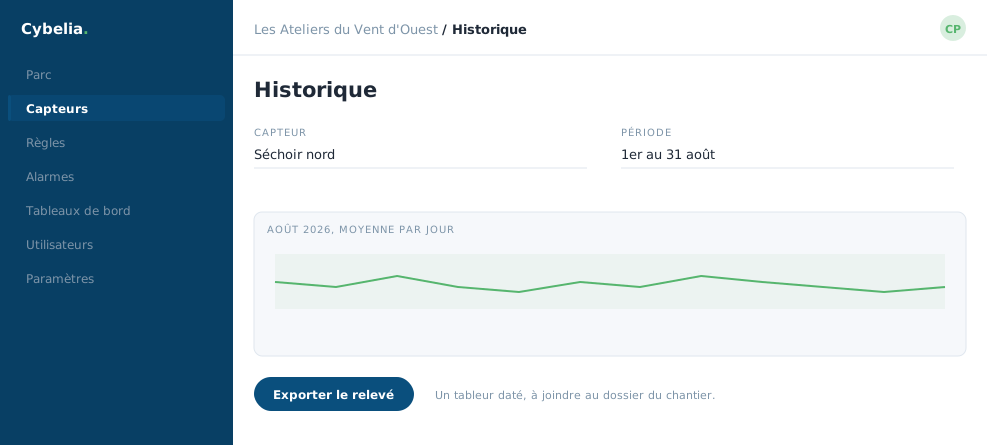 History is kept: that is what lets you prove things afterwards.
The history of readings
Every value received, with its time. It is where the curves come from, and where the exports come from when a customer, an insurer or an inspector asks for evidence.
The classic case: a customer complains that a door has moved. You pull out the kiln readings for the period it was made. Either they show correct drying, and the conversation turns to something else; or they show a drift, and you know what to fix. Either way you have stopped guessing.
The history of alarms
Every past alarm, with who took it on, when, and how it ended. That is what lets you say after a year: "kiln 2 drifted three times, always in February, always at night". At that point you are no longer fixing an alarm: you are fixing a cause.
History cannot be rewritten. A recorded reading cannot be edited, a past alarm cannot be erased. That is what gives the export its value: a file you could have touched up would prove nothing at all.
The trail of actions
The actions that matter, creating or changing a rule, moving a threshold, taking on an alarm, adding a user, leave a time-stamped trail. This is not surveillance of people. It is what lets you answer "why weren't we told on the 12th?" with "because the rule was paused on the 11th for maintenance and never switched back on". An answer, rather than a suspicion.
What is backed up
Your readings, your rules, your dashboards and your alarms are backed up by Cybelia Cloud at the frequency set out in your contract. There is no backup for you to run, and nothing to install for it.
In closing
The history answers two distinct questions: what happened, and who did what. The first is for understanding, the second for proving, not least to a customer or an inspector.
Commenting is not enabled on this course.