The "My held messages" screen
The list, and what it actually tells you
This is the portal's home screen. One line per held message: who wrote, what subject, when, and above all why it was set aside. That last part is written in plain language, not jargon.
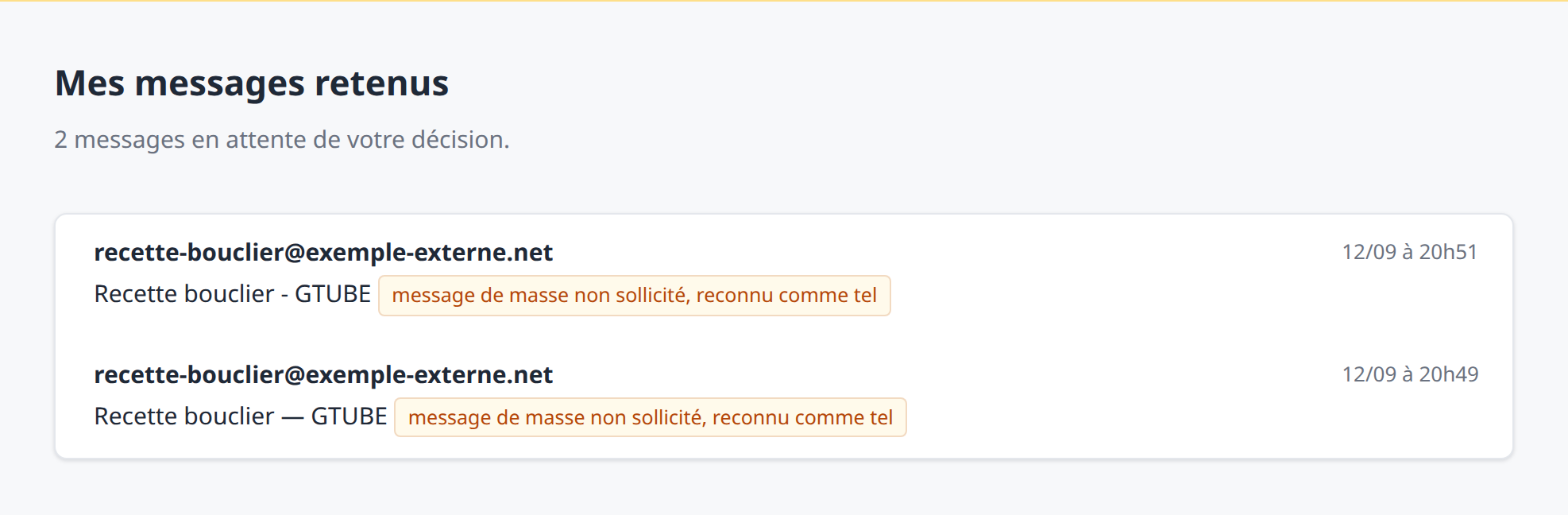 Two held messages, with their reason spelled
out.
Two held messages, with their reason spelled
out.
The reasons you will see
The Bouclier never shows a score or a mark out of ten. It says what it saw, and the reasons fall into three families.
| What can harm | What it means |
|---|---|
| Dangerous attachment | The attached file is of a kind used to install a program. This reason is rarely a mistake. |
| Attachment of a risky type | The file format can carry code. A genuine document can end up here. |
| Contains a link reported as dangerous | An address quoted in the message is known for hosting traps. |
| What puts the sender in doubt | What it means |
|---|---|
| The sending domain rejects this message | The company named declares itself that this message did not come from them. This is the impersonation reason. |
| Sender not authenticated | The sending server is not allowed to write on behalf of that domain. A small, badly configured supplier sometimes lands here by mistake. |
| Message signature missing or invalid | The message is not sealed, or the seal no longer matches. |
| Sending server reported for bulk mailing | The sending machine appears on a public list of bulk senders. |
| What is a matter of resemblance | What it means |
|---|---|
| Looks like messages you have already discarded | The filter has learned from your past decisions. |
| Layout typical of junk mail | The message's presentation, not its content, looks like a mass mailing. |
| Unsolicited bulk message, recognised as such | The message declares itself as a test or bulk send. |
Each person sees their own quarantine, and only theirs. Farida does not see Yanis's held messages, and neither does Camille: everyone's mail stays their own.
Rating
Commenting is not enabled on this course.