Know-how : writing the house procedure
The /savoir-faire page
A know-how is a procedure written by you: the way your company chases a late payment, builds a quote, welcomes a new customer. A colleague's identity says who it is; a know-how says how things are done here.
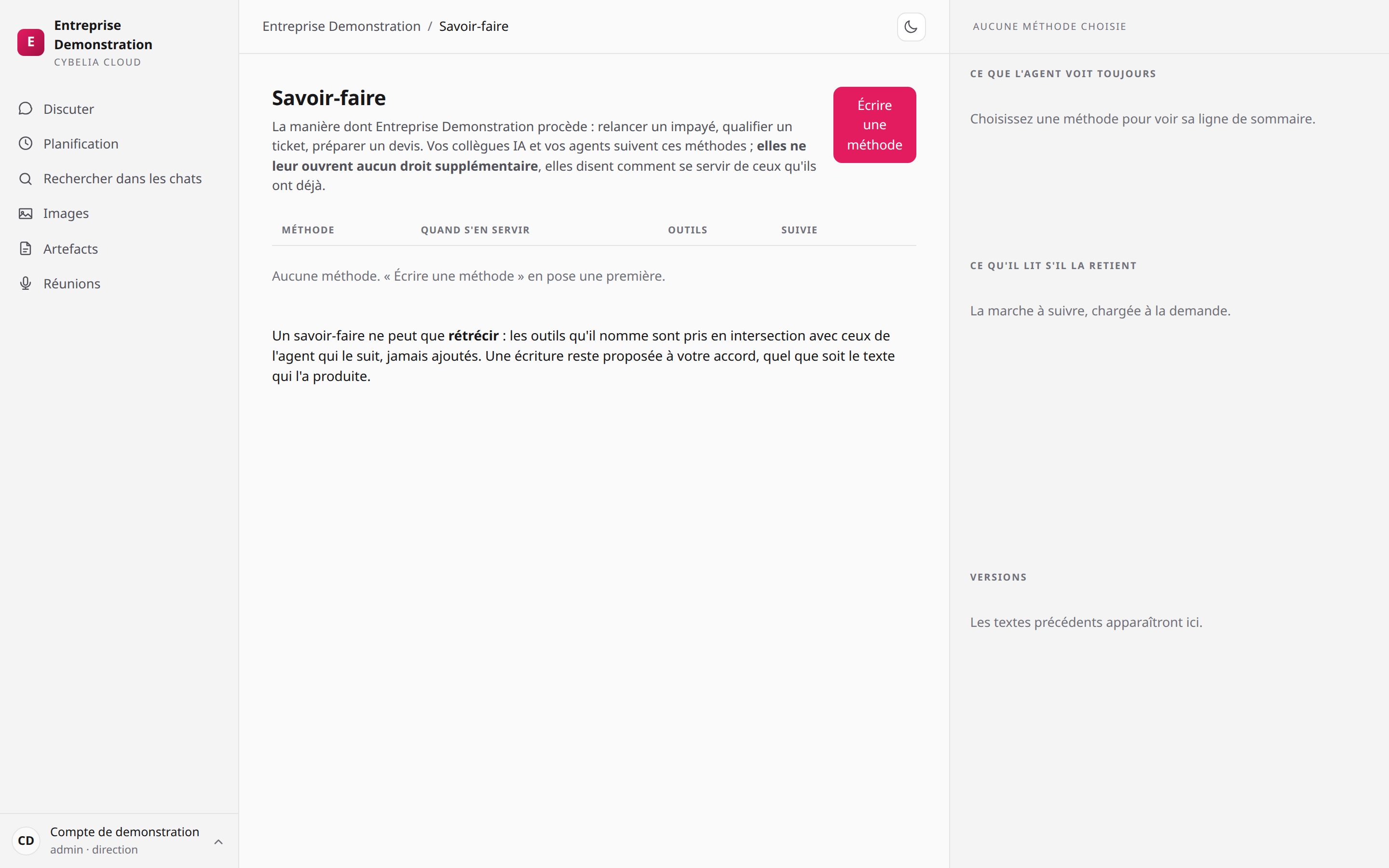 The workshop's know-how, written down once and applied thereafter.
Four fields, and the third carries everything
- The title, what the agent reads in the table of contents.
- When to open it, the sentence that decides. "When a customer has not paid an invoice more than thirty days overdue." One line only: it is a signpost, not a summary.
- The procedure, the steps, in order, as for someone starting the job on Monday.
- It is finished when, the stopping criterion. Without it, an agent carries on as long as it has steps left.
The contents list goes down, the procedure does not
On each run, the agent receives the contents list: one line per know-how, its title and when to open it. The full text only goes down if it asks for it, or if you name it at the outset. This is not thrift for thrift's sake: twenty-one one-page procedures, sent in advance to each of the eight steps of a run, would fill the model's memory before it had read your request.
A know-how grants no new permission. The tools it names are taken as an intersection with the agent's own, never added. If the agent lacks the tool, the procedure still goes down, saying so. Better an agent that knows what it is missing than one that finds out by failing.
What has been used is not rewritten
Every edit creates a version. A run's log keeps the version number that guided it, and that day's text. Reading back six months later why an agent proceeded as it did only makes sense if you read what it had in front of it.
At the joinery
Sarah has written three know-hows: the 30-day reminder, the 60-day reminder, and welcoming a new customer. Three pages. It is what she explained to every new recruit, except that she will not explain it again.
In closing
Identity says who it is, know-how says how things are done here. It is that second point that makes an answer look like your house rather than an average of the web.
Commenting is not enabled on this course.