Asking well : six habits that change everything
The most useful lesson in this course
An AI gives back what it is given. The difference between a hollow answer and a useful one rarely lies in the tool: it lies in what was in the question. Here are six habits, in order of what they return.
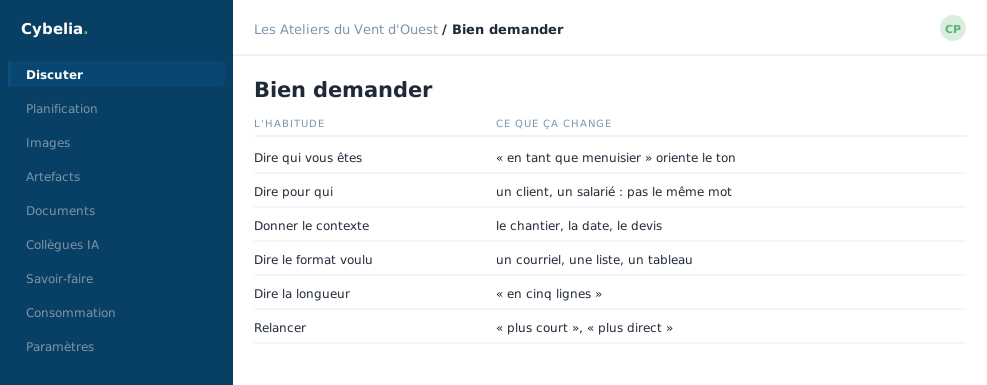 Six habits, and opposite each what it changes in the answer.
1. Say what you want to get, not just the subject
"The Delaunay contract" is not a request. "Summarise the delivery commitments in the Delaunay contract, in three lines, for an email" is one: the subject, the shape, and the use. The third is the one everyone forgets and the most valuable, you don't write the same way for an email and for a site meeting.
2. Give it the context you have in front of you
It cannot see your screen. Paste the extract, attach the file, name the folder. An attachment costs one second and saves three rounds of back-and-forth.
3. One conversation per subject
A thread that jumps from recruitment to invoicing becomes a thread where it hesitates between two contexts. Open a new conversation: it costs nothing, and the thread you find again six months later will be readable.
4. Correct it in the thread, not in your head
"No, the discount applies to the pre-tax amount" beats starting the question over. It takes the correction into account for the rest of the thread; and if it is a lasting fact, you can ask it to remember it.
5. Ask for sources when it matters
On a figure, a date, a clause: "where did you get that from?" It cites the document. If it cannot, it filled a gap, and you have just found that out before your customer did.
6. Break up what is big
A request with eight points returns eight mediocre answers. The same eight points asked one after another, each building on the last, return eight accurate ones. It takes longer to type and far less time to check.
What does not work, and what everyone tries: insisting. Repeating the same question more loudly changes nothing. Rephrasing it, or giving it what it was missing, changes everything.
In closing
Six habits, and the first alone already changes your results: say what you want to get. An AI gives back what you give it, and this is the most profitable lesson in the whole course.
Commenting is not enabled on this course.