Who it is for
Wherever a measurement prevents a loss
A sensor is not justified by the technology but by what it prevents: goods lost, a breakdown found too late, an energy bill you simply endure. Here are the activities where measurement pays for itself fastest.
 Three trades, and what each comes here for.
| You are | What measurement saves you |
|---|---|
| Warehouses, logistics, cold rooms | A break in the cold chain overnight, a unit failing on Saturday, and stock to be thrown out on Monday for want of proof otherwise. |
| Food industry and food trades | Temperature readings copied out by hand, and the inspection that asks for the last twelve months of history. |
| Workshops, industry, subcontract manufacturing | Extraction or the compressor stopped without anyone hearing it, and the production hours lost behind that. |
| Construction, finishing trades, drying | A batch fitted too damp, the warranty rework, and the argument with the client with no evidence either way. |
| Building managers and property agents | Heating running in an empty room, a leak flowing all weekend, a consumption that drifts for no reason. |
| Local authorities and public buildings | Air quality in a classroom, mandatory energy monitoring, and reports to produce without dedicating a post to it. |
| Healthcare, pharmacies, laboratories | Temperature-sensitive products and traceability demanded by regulation, not by convenience. |
| Farming, wine growing, greenhouses | Frost announced too late, irrigation by guesswork, a tank you monitor by driving out to it. |
| Remote sites, plant rooms, technical spaces | An unstaffed room overheating, a door left open, a power cut you find out about the next day. |
And inside the company, who uses it?
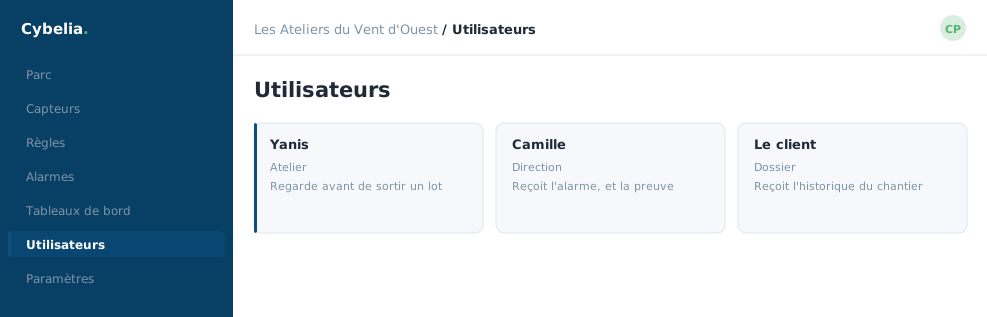
Cybélia IoT asks for no technical skill. It asks you to know what is serious in your trade and what isn't. Here are the four people at Les Ateliers du Vent d'Ouest, and what each of them gets out of it.
| Who | What it gives them | What they open first |
|---|---|---|
| Camille management |
Sees the month's electricity use and the overall state of the estate. Decides whether more sensors are worth it. | The dashboard. |
| Farida administration |
Receives alarms by email, keeps track of who is told what, prints a record when a customer asks for one. | The alarms. |
| Yanis workshop |
Checks the kiln humidity before taking a batch out. Gets the alert on his phone when the extraction stops. | The kiln's record. |
| Tom apprentice |
Looks, and learns to read a curve. Changes no settings, and that is exactly right. | Today's curves. |
You cannot break the tool by clicking. Reading a value, zooming into a curve, opening an alarm: none of that changes anything. The actions that do change a setting are reserved for people who have the right to them, and they can be undone.
And if nobody is looking?
That is the normal state of affairs, and it is deliberate. A measuring tool that has to be watched is no use at all. You open Cybélia IoT in two situations only: when you have received a message, or when you want to check one particular thing. The rest of the time it works without you.
In closing
Cybélia IoT is for any activity where a physical value, temperature, humidity, current, presence, has consequences for money or for safety. You do not have to become a technician: you have to say what counts as serious in your business. The rest, the measuring and the alerting, runs without you.
Commenting is not enabled on this course.