Secrets forgotten in the code
"Detected secrets" page
When you build a small in-house tool, a script that sends out quotes, a page that queries the database, you sometimes write a password straight into it, "just for testing". Then you forget it. This page goes and finds them.
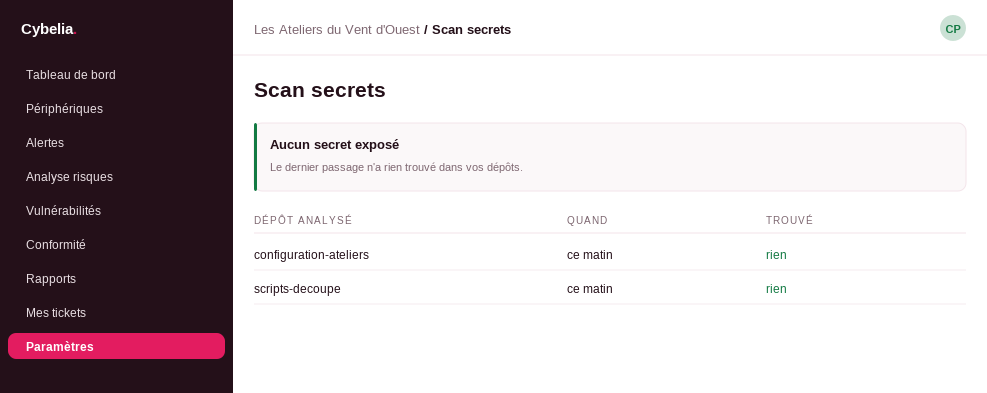 Passwords left behind in code: the last sweep found nothing.
What it shows
Each line gives the type of secret found, the file, the line number, the detection date, and a masked value. The secret itself is never shown in full: seeing that it exists is enough to decide.
Four counters at the top: the total number of findings, those still open, those judged critical and needing rotation, and the number of code repositories watched.
Two possible answers
Mark as rotated: you have replaced the password concerned. The line closes. False positive: it was not a real secret, an example in some documentation, a dummy value. The line closes too, and the tool learns.
No blame. Everyone has left a password lying in a file at some point. What matters is not never doing it, but seeing it and fixing it. This page exists for that, not to name a culprit.
Does this concern me?
If your company develops nothing, the page stays empty and displays a message saying so. At Les Ateliers, a former intern had written a small export program; two lines came up, they were dealt with in half an hour, and the page has been empty ever since.
A severity filter and a free search help you sort things once the list grows. Everything exports to a spreadsheet, to discuss with whoever wrote the code.
In closing
A password written "just to test" survives for years. This page finds them; it is up to you to take them out of the code and change them, in that order, because a published secret must be treated as known.
Commenting is not enabled on this course.