In every company, a vital share of knowledge is written down nowhere. It lives in the head of a machine setter, an accountant, a sales rep, an executive. Geoiko, an artificial intelligence and strategic innovation consultancy based in La Roche-sur-Yon, and Cybelia Cloud are teaming up around a simple idea: build the company's digital twin, and make it possible to ask it questions.
Two crafts, one project
Geoiko helps business leaders in Vendée and the Pays de la Loire region turn technology into useful, lasting decisions. Its approach brings together strategy, artificial intelligence, digital transformation, IoT and the capture of know-how.
Cybelia Cloud builds and runs the resulting solutions: ERP, connected devices and AI assistants, hosted in France on its own secure infrastructure.
- Geoiko asks the right questions: which knowledge matters, which decisions depend on it, where to start.
- Cybelia Cloud puts the answer into service, and keeps it running.
The knowledge that walks out the door

Photo: “Carpenter sanding a chair with sandpaper in a small workshop,” Ivan Radic, licensed under CC BY 2.0.
A retirement, a business handover, an expert changing roles, a fast-growing team: every time, part of the know-how is at risk of leaving. Written procedures don't tell the whole story. They don't explain why machine 3 is set up differently in winter, which customer prefers a morning call, or how a particular issue was solved two years ago.
Yet this knowledge is what gives a company its value. Losing it costs months of trial and error. Passing it on takes time, and time is always short just when it's needed most.
The company's digital twin
A digital twin is a living copy of a real-world system. In industry, it replicates a machine or a plant. Applied to an entire company, it brings together in one place:
- its data: sales, purchasing, inventory, production and accounting, managed in the ERP;
- its measurements: sensors, machines, buildings and energy, when they are connected;
- its documents: procedures, contracts, technical data sheets, meeting minutes;
- its memory: the know-how of its experts, gathered through interviews and put into shape.
The difference from a traditional document repository comes down to one thing: you don't dig through it, you ask it. In plain language, as you would an experienced colleague: “How do I handle a return from this customer?”, “Why has the margin on this product line dropped?”, “What should I do when this defect shows up?” The assistant answers, and cites the documents, data and knowledge sheets it relies on.
Ask instead of search
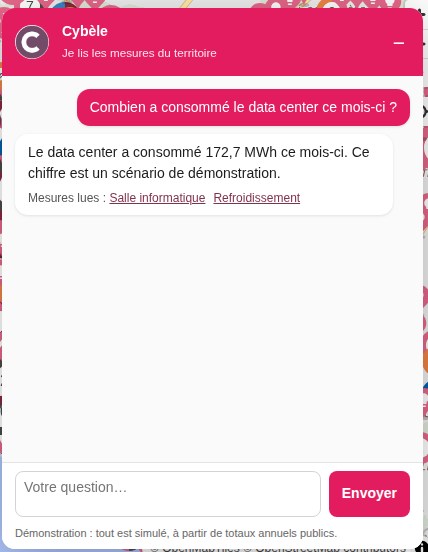
Cybèle, Cybelia Cloud's AI assistant, answers and cites what she has read.
Asking changes the way people work. New hires find answers without interrupting the expert at every turn. Executives can cross-reference ERP data with an explanation from the shop floor without waiting for a report. And experts no longer have to repeat the same thing a hundred times: they pass it on once, and their answer stays available.
A sourced answer can be verified. That is the rule we apply: the assistant states where it read what it claims, and calculations are done by code, not guessed by the model. Like any AI, it can make mistakes; the source makes them visible.
Knowledge transfer, planned rather than endured
Photo: “Mark across diagonals,” Jordanhill School D&T Dept, licensed under CC BY 2.0.
The digital twin proves its full value at handover time. A few months before leaving, the expert describes their craft: their techniques, their reference points, their exceptions, the mistakes to avoid. These interviews become knowledge sheets they review themselves, stored in the twin and linked to the data they explain. Their successor inherits a go-to resource available around the clock, one that speaks the company's own language.
The same principle supports a business handover: the buyer gets to know the company by asking it questions, and the seller passes on what no balance sheet shows.
Day to day, department by department
- On the shop floor: how to set up a machine depending on the material and the season, what to do when a defect appears, the history of breakdowns and their causes. With sensors, the twin links the explanation to the current reading.
- In sales: each customer's habits, negotiated terms, the reasons behind a discount, cross-referenced with actual sales in the ERP.
- In administration: special billing rules, due dates, the once-a-year procedures nobody remembers anymore.
- In management: a question put to the whole organization, with data and know-how combined, without waiting for a dashboard to be consolidated.
What a digital twin doesn't do
It doesn't replace the expert: it extends them, and it only knows what it has been given. A question outside its scope gets an honest answer, “I can't find this information,” rather than a made-up one. Nor does it make decisions: it informs a decision that remains human.
Finally, it calls for a bit of discipline. Know-how that changes has to be updated, just like a procedure. That's why every knowledge sheet has an owner, and why unanswered questions are tracked: they show what still needs to be captured.
How a project unfolds
- Scope, with Geoiko: which knowledge is critical, who holds it, which decisions depend on it, which access rules apply.
- Gather: existing documents, ERP and sensor data, recorded interviews with the experts.
- Structure: each piece of knowledge becomes a short, sourced knowledge sheet, reviewed by the person who holds it.
- Go live, with Cybelia Cloud: the assistant answers from these sheets and the data, respecting each user's access rights.
- Keep it alive: a sheet is corrected when practice changes, and an unanswered question flags knowledge still to be captured.
Your data stays yours
A digital twin holds a company's most valuable assets. That's why it is hosted in France, on Cybelia Cloud's infrastructure, and the AI model runs there too: nothing is sent to a foreign provider for analysis. Each user sees only what their access rights allow. The company remains the owner of its data and can retrieve it at any time.
An example already in service
Cybelia Cloud has built a demonstration of this principle at the scale of a region: a smart grid with more than 6,000 simulated sensors, eleven dashboards, and Cybèle, the AI assistant that answers from the measurements and cites the equipment it read. It is a regional digital twin, to be questioned so you understand before you decide. A company is simply a smaller territory, with its own flows, equipment and know-how.
Where to start
A first project often fits within a single scope: one workshop, one department, one expert leaving in a year. That's enough to measure the benefit, and small enough to move fast.
To discover Geoiko's approach: geoiko.com. To talk with Cybelia Cloud: contact@cybelia-cloud.fr. Our partners: cybelia-cloud.fr/partenaires.