Connecting a machine, a cash register, or a meter to online software almost always raises the same question: what needs to be opened up in the company network? With the Cybelia IoT Box, the answer fits in one word: nothing.
Security first: a box that only connects outward
Many connected solutions require port forwarding, remote access, or a permanent tunnel. Each of these openings is one more door to monitor, and one more door that bots are constantly probing on the internet.
The Cybelia IoT Box works the other way around: it makes the call, never the outside world. It establishes an outbound, encrypted connection, just as a web browser would, and receives its work through that channel. For your business, this changes several things:
- Nothing to open on your firewall. No inbound ports, no VPN to deploy, no exception rules to maintain and justify.
- Nothing to attack from the internet. The box does not wait for any connection from outside. A scan of your public IP address doesn't see it.
- Your machines stay protected. PLCs and equipment are never exposed: they talk to the box, on your local network, and only the box communicates with the outside world.
- A unique identity for each box. Each one is linked to your account individually and can be removed on its own, without affecting the others.
- A local screen reserved for your network. The box's administration interface responds only on the private network, behind a password.
A box is no substitute for a security policy. It simply avoids adding a vulnerability just to connect your equipment.
One box, a wide range of uses
The same box works just as well for a retail store, a factory, or an energy network. It all depends on what you plug into it.
- At the counter. The point-of-sale receipt printer, cash drawer, scale, scanner, and customer display: the POS controls them without installing anything on each workstation.
- In the office and the warehouse. Document and label printers, scales, and inventory scanners, connected to your ERP.
- On the shop floor. PLCs, drives, and machine tools, right up to the OPC UA connection of a machining center: machine status, part counters, temperatures, and alarms flow into your dashboards.
- In the building. Boiler rooms, air handling units, meters, UPS units, and ambient sensors in the server room.
- Across a region. Energy meters, solar inverters, power monitoring units, and long-range sensors: the building blocks of a smart grid, which makes the energy production and consumption of a neighborhood or town easy to understand.
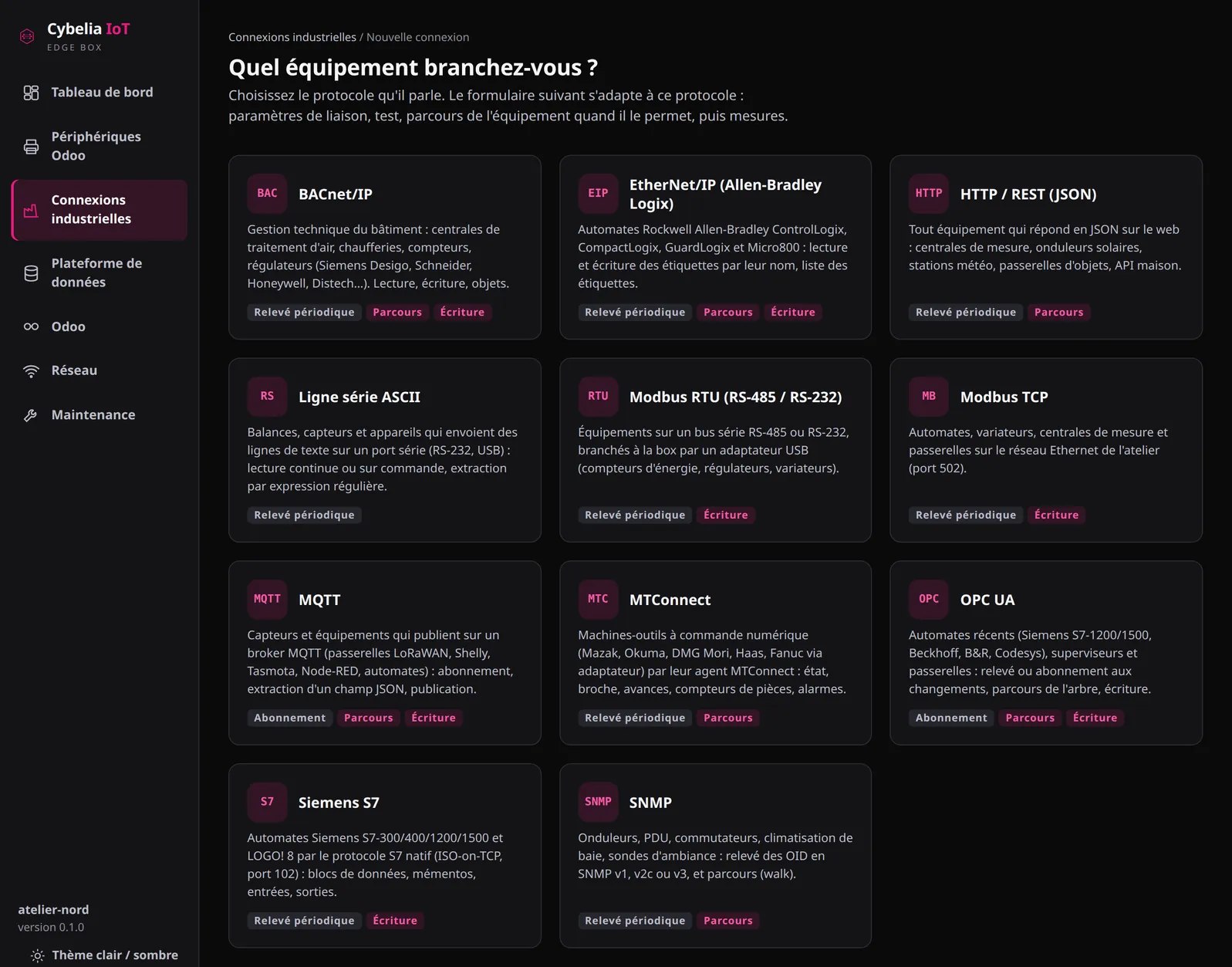
On the box's screen, choosing the equipment to connect: PLCs, machine tools, building management systems, sensors, networks.
Data that never gets lost
If the internet connection goes down, the shop floor doesn't stop, and neither do the measurements: the box stores them and sends them in order once the connection is back. On its dashboard, you can see at a glance what is active, what is pending, and what needs your attention.
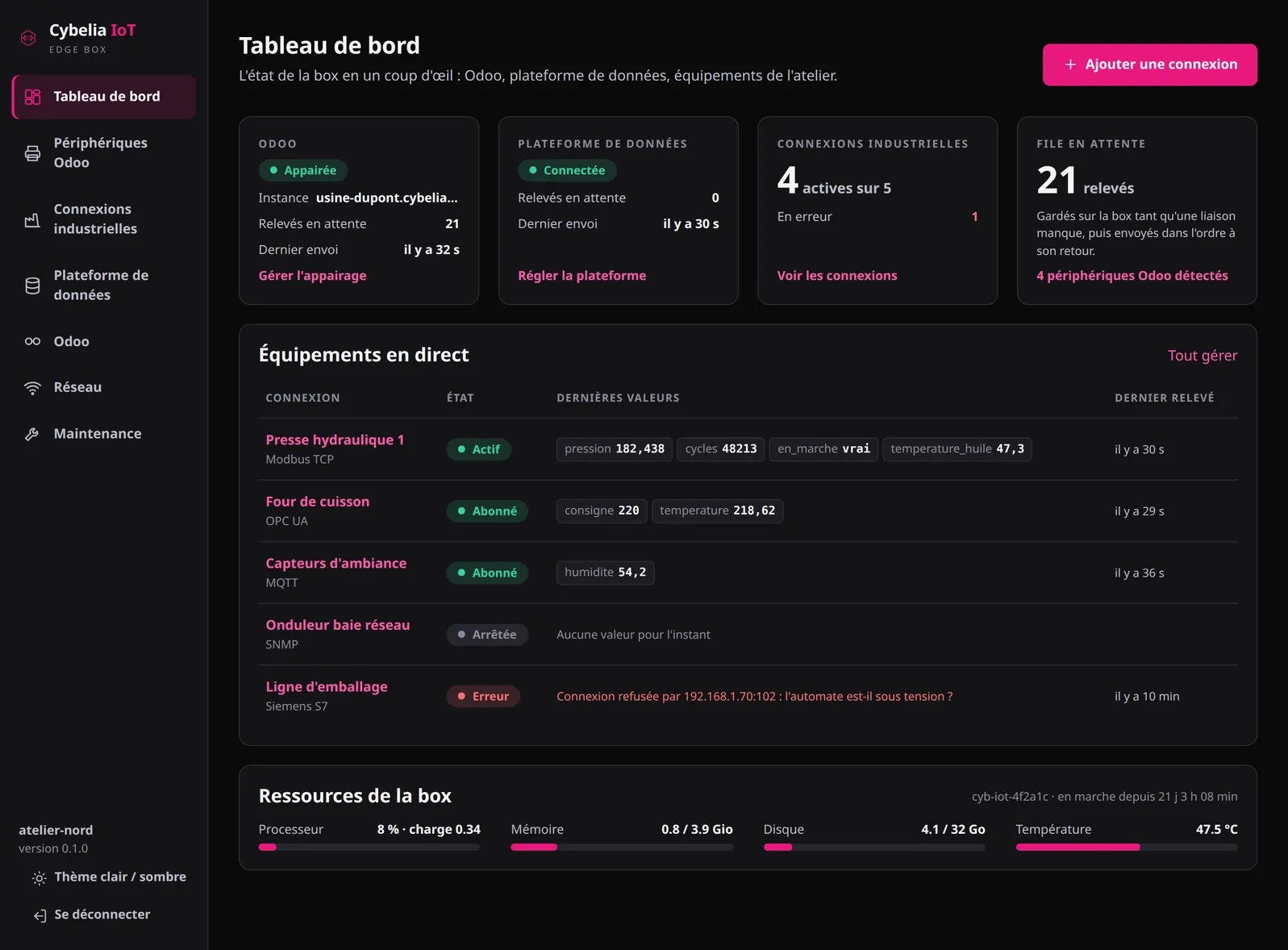
The box's dashboard, shown here with sample data.
Your equipment, your use case
A register to connect, a machine to monitor, energy consumption to understand: every site is different. Let's talk about your equipment, or discover the two Cybelia IoT Box plans.